
Brantley County Criminal History Checks
Begin by defining the question. Current custody belongs with the Brantley County Sheriff's Office and jail; a filed felony belongs with the Georgia E-Access provider for Brantley Superior Court and the clerk; a statewide felony-conviction possibility belongs with Georgia Felon Search. A complete review of one's own Georgia history calls for a fingerprint-supported GCIC inspection.
Collect the full legal name, date of birth when the official form permits it, approximate event date, case or booking number, and spelling or alias variations. A name match alone is not proof of identity. Case numbers narrow court results, while fingerprints are the official way to confirm that a statewide history belongs to the person being checked.
- Choose the holder: sheriff or police for an arrest report, jail for custody, or the clerk for a filed case.
- Search Brantley Superior through E-Access using a case number when known or a name with date, status, and case-category filters.
- Compare identifiers carefully and read the outcome for each charge rather than assuming one result governs the whole case.
- Call the clerk at 912-462-5635 for missing documents, archived files, or the current plain-copy and certification charges.
- Use GCIC personal inspection when identity accuracy and a subject's statewide record matter.
Four Places a Brantley Record Can Live
An arresting agency writes the incident or arrest narrative. Brantley County Jail creates the booking and custody entry. The clerk maintains the accusation or indictment, docket, orders, plea or trial result, and sentence. GBI's Georgia Crime Information Center receives fingerprint-supported arrest cycles and dispositions reported by justice agencies. None of these products is a substitute for all the others.
| Source | Best use | Important limit |
|---|---|---|
| Sheriff or police | Incident and arrest narrative | Does not establish the final filed charge |
| County jail | Booking, bond, and current custody | Status changes and booking is not conviction |
| Superior Court clerk | Docket, filings, disposition, certified copies | Not a complete statewide arrest history |
| GCIC | Reported Georgia history tied to identity | May await local disposition reporting |
Official Background Checks in Georgia
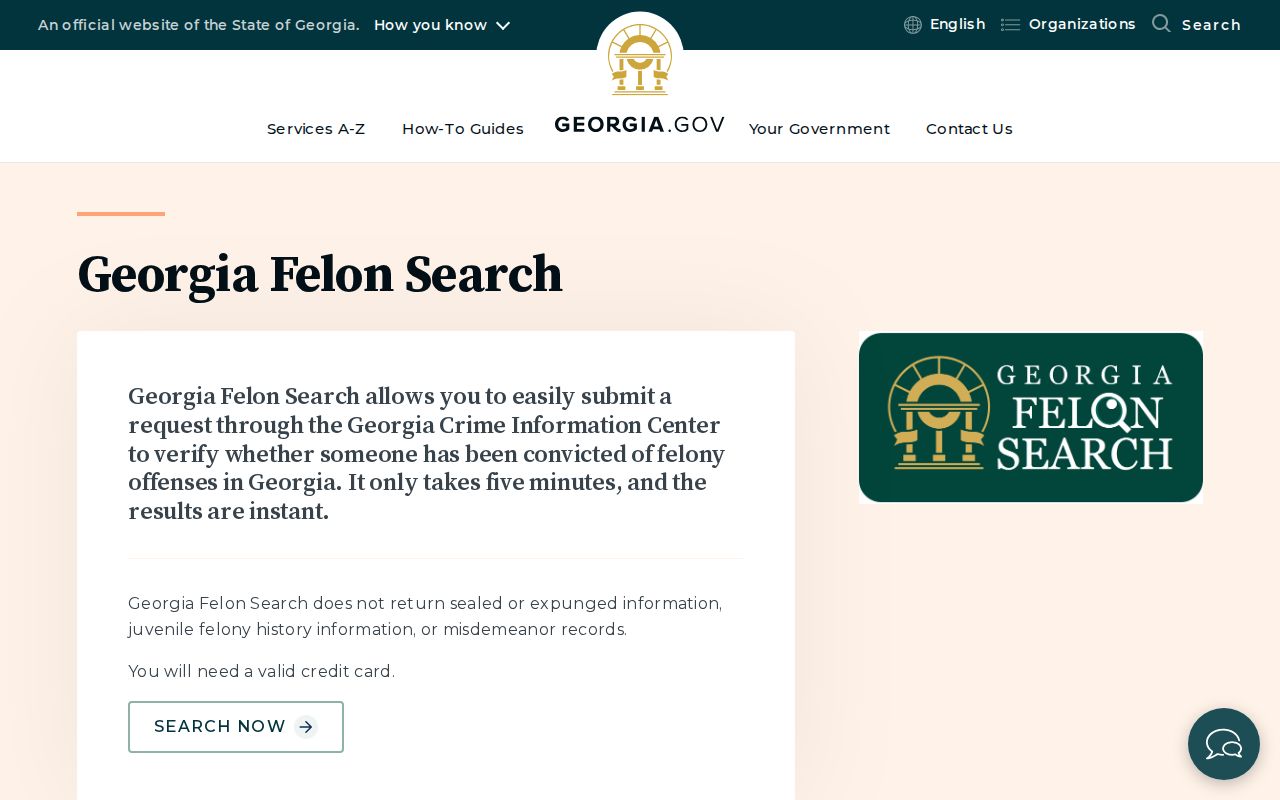
The Georgia Bureau of Investigation and GCIC maintain the central repository. Georgia Felon Search is a public, name-based product limited to possible Georgia felony-conviction matches. It asks for first and last name, exact date of birth, sex, and card payment. It omits misdemeanors and restricted, sealed, or juvenile information, so a blank result is not a clean statewide history.
For personal review, most Georgia sheriff or police departments can provide a Georgia history under local rules, while the GCIC lobby in Decatur offers appointment-only inspection and fingerprinting. GAPS routes electronic fingerprints for checks authorized by an agency; it is not a public search-anyone portal. No approved GAPS site inside Brantley County was confirmed, so use the agency registration message and current scheduler rather than assuming a local location.
Georgia Felon Search Has Narrow Limits
The product name can sound broader than it is. Georgia Felon Search returns possible felony-conviction matches, not every arrest, misdemeanor, pending case, federal prosecution, out-of-state event, or record hidden by law. Its instant result should be treated as a lead. A fingerprint comparison is the official method for confirming identity, and the originating clerk remains the source for the actual disposition and certified court documents.
For a subject's federal identity-history record, the FBI Identity History Summary is a separate fingerprint-based, subject-only process through FBI eDO. It does not replace the Brantley court file. Verify the current federal fee within the ordering portal before submission.
Kinds of Criminal Records
Brantley records describe different stages of the justice process. An incident report records observations and alleged conduct; a booking sheet documents intake; an accusation or indictment states filed charges; and the court docket tracks hearings, orders, disposition, and sentence. A GCIC history assembles reported Georgia arrest cycles and outcomes, while warrant, supervision, correctional, and sex-offender systems answer narrower questions.
Custody determines the next source. The county jail handles local detention, but a sentenced person transferred to Georgia custody may appear through GDC Find an Offender instead. Department of Community Supervision records relate to felony probation and parole field supervision; the court judgment remains the best source for the original sentence.
- Arrest and booking records - agency narratives and jail intake data show allegations, initial charges, bond, and custody.
- Criminal court files - clerk-held dockets show the filed case, events, orders, outcome, and sentence.
- GCIC histories - identification and reported Georgia arrest cycles are subject to access and dissemination rules.
- Warrants - issuing courts and law enforcement track them; no verified public Brantley warrant list was found.
- Supervision and registry records - DCS, GDC, the parole board, sheriff, and GBI each maintain distinct portions.
Finding the Right Brantley Records Counter
Current court-office references point to 234 Brantley Street in Nahunta, while 117 Brantley Street is associated with the historic courthouse. That distinction matters before an in-person visit. Confirm the suite and counter with the Clerk of Superior Court at 912-462-5635 rather than assuming the historic building contains the working records office. Ask whether the file is electronic, paper, archived, or sealed and whether certification is required.
Superior Court Clerk
234 Brantley St., Nahunta, GA 31553
Felony case files and certified copies
912-462-5635
Brantley County Sheriff
Official sheriff site
Agency reports, jail information, warrants, and local registration
GBI / GCIC
Criminal-history FAQ
State repository and personal inspection guidance
Brantley County Criminal Records: What They Contain
A Georgia criminal history can contain identification descriptors, the arresting agency and date, charges, final judicial dispositions submitted by courts or prosecutors, and correctional custody information. Public-facing products suppress protected identifiers and may omit restricted, juvenile, or sealed segments. A court file adds docket events, attorneys, charging instruments, hearings, orders, financial entries, and any public linked documents.
| Name & Identifiers | Name, aliases, date of birth and physical descriptors; protected numbers are not ordinarily public. |
|---|---|
| Arrest / Booking Data | Agency, date, intake time, booking number, initial charges, bond and release or custody status. |
| Charges & Statutes | Offense description, cited Georgia law, count, and filed charging instrument. |
| Disposition | Outcome for each charge, including conviction, dismissal, acquittal, nolle prosequi, or other status. |
| Sentence | Confinement, probation, fines, restitution and whether terms run concurrently or consecutively. |
| Custody / Supervision Status | Published jail, GDC, probation or parole information, with source-specific limits. |
Where the Jail Search Stops
No stable official online Brantley jail roster was verified in the research. For a recent booking, use the sheriff's jail-information channel or call the jail and supply a full name and approximate arrest date. Telephone verification is useful for time-sensitive custody but is not a formal copy request. Ask separately for the booking record and the arresting agency's narrative.
County custody and state custody are separate. After sentencing and transfer, a person may disappear from a local custody view and appear in GDC Find an Offender. The state locator can be searched by GDC ID or case number, or by name and demographics. It does not replace the court judgment, and detailed probation notes are not a general public profile.
Georgia Public Access Laws
Georgia's Open Records Act presumes access to agency records, but the request belongs with the custodian: the clerk for case files, the arresting agency for reports, and the jail for booking or custody. Describe an existing record and date range. An agency need not answer research questions or create a new compilation. Exempt portions may be redacted while segregable public material is released.
Key Statutes:
O.C.G.A. § 50-18-70 - establishes the state's presumption of access to agency records.
O.C.G.A. § 50-18-71 - requires a response generally within three business days and written timing, cost, or exemption details when production is delayed.
O.C.G.A. § 50-18-72 - protects specified investigative, privacy, and other exempt material.
O.C.G.A. §§ 35-3-34 and 35-3-35 - govern dissemination of Georgia criminal-history information.
O.C.G.A. § 35-3-37 - sets Georgia's record-restriction process.
Three Days Means a Response
The Open Records Act's three-business-day period is not a promise that a large file, archived case, body-camera video, or heavily redacted production will arrive in three days. If an agency cannot produce records within that period, it generally must respond in writing with expected timing, estimated cost, and any legal basis for withholding. Request an estimate before extensive retrieval or video redaction begins.
| Requested item | Brantley route | Published amount |
|---|---|---|
| Incident or arrest report | Agency that created it | No local official fee located; request an estimate |
| Booking or local-history product | Sheriff or jail | Product and fee not published in research |
| Court copy or certification | Superior Court clerk | Call 912-462-5635 for current charge |
| Body-camera or 911 media | Recording agency | Ask for actual retrieval and redaction estimate |
Restricted, Sealed & Expunged Records
Georgia uses record restriction for limiting ordinary dissemination; it does not destroy the record. Qualifying nonconviction results can include dismissal, nolle prosequi, dead docket, no grand-jury presentation, or no record on file, though eligibility depends on the statute and outcome. Juvenile records are generally confidential unless the youth was handled as an adult, and successfully completed First Offender matters receive special protection.
For arrests before July 1, 2013, the application normally routes through the arresting agency and prosecutor. For later arrests, begin with the prosecuting attorney. If approved information cannot be sent electronically, follow the current Georgia restriction instructions for submission to GCIC. Authorized justice agencies can still access restricted history, and restricting GCIC data is distinct from sealing a court file.
A Dismissal Is Not Automatic Restriction
A dismissed charge can remain visible until the statutory restriction process is completed, and a court docket may require a separate sealing analysis. If information is wrong or a disposition is missing, obtain the record, identify the arrest cycle or case entry, and contact the agency or court that owns the source data. GCIC cannot invent a missing local outcome. Preserve certified orders and the completion letter when following up.
- Restriction
- Limits public and private dissemination while retaining authorized justice access.
- Sealing
- Hides a court record from ordinary public access under legal authority.
- First Offender
- A Georgia procedure that may avoid adjudication of guilt after successful completion for a qualifying person.
City-by-City Criminal Records in Brantley County
Brantley County has two incorporated cities, not three. Nahunta Police holds reports its officers create, and Hoboken municipal records must be sought through the current city contact when that city handled the event. City arrestees may still be booked at Brantley County Jail, while filed felonies move to Superior Court. Waynesville and Hortense are unincorporated community names and do not automatically identify a city police custodian.
Nahunta Record Check
County seat · Start with Nahunta Police for city reports, then use the county jail or clerk for bookings and felony cases.
Hoboken Record Check
Former county seat · Confirm whether the city, sheriff, or state patrol created the record before making a request.
Rural Addresses Can Misroute Requests
Brantley's 443.2 square miles and small incorporated-city structure make agency identification especially important. A community name in a mailing address does not prove that a city officer handled the event. The sheriff may hold records for incidents outside incorporated limits, Georgia State Patrol may hold highway enforcement or crash material, and a city department keeps the report when its own officer created it.
The county seat moved from Hoboken to Nahunta in 1923, which helps explain why older references and present-day offices point to different places. Today Nahunta is the practical records hub. Before sending a request, identify the officer or agency on the citation, booking entry, or incident number; then request the narrative from that custodian and any separate booking or court record from its own holder.